 Mark Parham
In this article
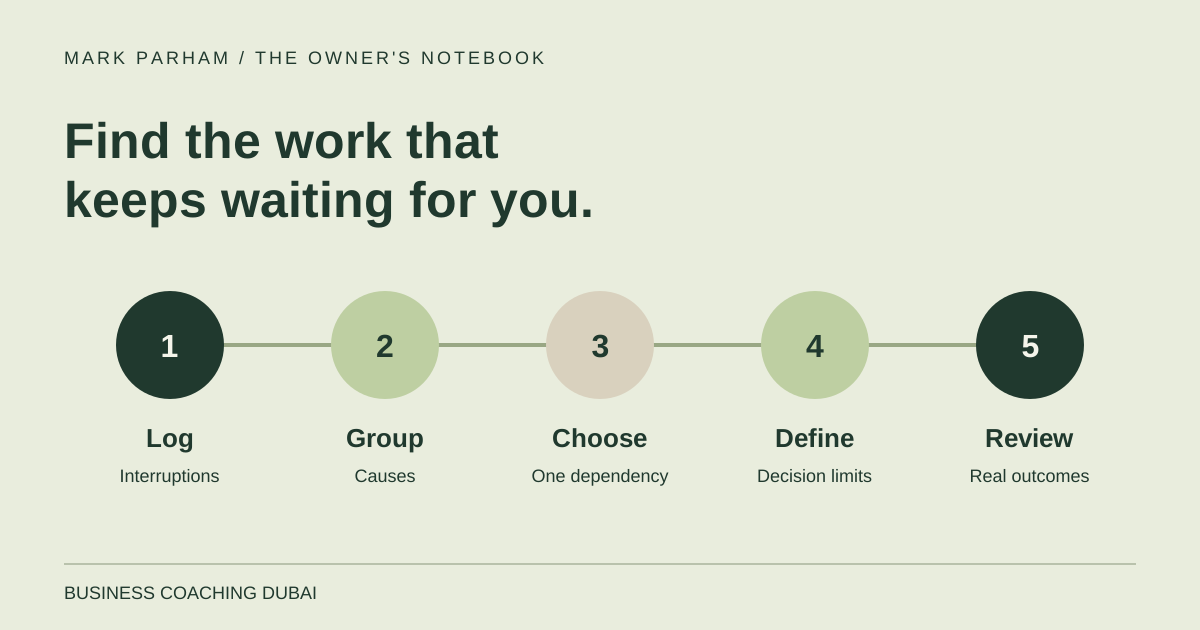
You are a bottleneck when ordinary work repeatedly waits for your decision, information or approval. To find out where that is happening, record the interruptions and waiting points for five working days. Then fix one repeated dependency, with clear ownership and boundaries.
The aim is not to make yourself irrelevant. Some decisions belong with the owner. The problem starts when a routine quote, a customer update and a strategic decision all join the same queue because nobody knows which things they can move forward without you.
If you run a business in the UAE and feel permanently busy, another productivity app may not be the first answer. I would look at the work that cannot move until you touch it. This five-day audit gives you something more useful than a vague instruction to delegate more.
First, distinguish a busy owner from a blocked business
You might spend a demanding week negotiating an important agreement, developing a new service or resolving an unusual issue. That does not automatically mean the business has an unhealthy dependence on you. The work may genuinely require your involvement.
A bottleneck is more specific. An employee knows the next step but lacks permission. A customer waits because only you know what was promised. A job cannot be scheduled because the information lives in your WhatsApp history. The recurring dependency matters more than how full your diary looks.
Ask a simple question: if I were unavailable for half a day, what would stop? Do not answer it alone. Ask the people who handle sales, delivery and customer questions. Their answers may be different from the tasks you think are taking your time.
Day one: record the interruptions without judging them
Use the audit sheet below. For each interruption, record the task, who needed you, what they were waiting for, how long you spent and whether the issue had happened before. Add the delay experienced by the work if you can estimate it reliably.
Keep this light enough to complete. A few words are enough: “Approval for routine reschedule; same conditions as yesterday; six minutes.” You are not asking the team to justify every question. Explain that you are examining how the business works, including the ways you may be making it harder.
For illustration, 12 interruptions averaging eight minutes total 96 minutes of direct involvement. That is useful information. It does not mean all 96 minutes were wasted, and it does not measure the separate cost of a customer or colleague waiting. Record those effects separately rather than adding uncertain figures together.
Day two: group the dependencies by their cause
At the end of the second day, group the examples. Was the missing item a decision rule, customer information, a skill, access to a system or simply confidence that the person was allowed to act?
Those causes need different responses. A written process will not solve missing system access. Giving someone authority will not help if they cannot see the order history. Training will not fix a rule that changes every time a different manager is asked.
Look for repetition within each group. One unusual dispute should not dominate the plan if routine scheduling decisions are interrupting you every hour. Note the frequency, consequence and ease of fixing each pattern. That gives you a better basis for choosing where to start.
Day three: separate decisions you should keep from decisions you can move
List the decisions you must retain for now. That might include significant commitments, sensitive personnel matters or exceptions beyond an agreed limit. The exact boundaries depend on your business, contracts and responsibilities. Do not transfer authority casually because a generic article says you should.
Next, identify a repeated decision that a suitable person could own with the right information and limits. Routine scheduling is often easier to define than a major customer settlement. Start with something you can observe and review without exposing the business to an avoidable risk.
For each candidate, ask: what does a good result look like, what can the person decide, what information do they need, and which exceptions must come back? If you cannot answer those questions, the handover is not ready. The work may need defining before it needs delegating.
Day four: write one usable decision rule
Imagine, as an example, that routine customer rescheduling always comes to you. Write a rule explaining the available slots, any agreed constraints, what must be checked before changing the booking, and which exceptions need approval.
Give the person access to the relevant information and explain the reason behind the rule. Ask them to talk through two ordinary examples and one exception. This shows you whether the instruction makes sense before a real customer is waiting.
Keep the rule short enough to use during the work. “Use your judgement” is not a decision framework. A five-page document nobody can find is not much better. Our guide to delegating decisions explains the decide, inform and escalate boundaries in more detail.
Day five: agree ownership and a review point
Name the person who owns the decision and make sure the rest of the team knows. If everyone still asks the owner because nobody is certain who is responsible, the dependency will continue even though you have written a process.
Agree how you will review the change. For a small first experiment, you might examine a handful of completed cases after a week. Look at whether the outcomes were appropriate, whether the rule was clear and whether any exceptions were missed.
Do not promise that the owner will never be involved again. The aim is to handle ordinary cases at the right level and make exceptional cases visible early. Good delegation should improve the quality of escalation, not simply reduce the number of messages you receive.
Measure waiting as well as your own time
Saving owner time can be useful, but the business benefit may appear elsewhere. Perhaps customers receive an answer sooner. Perhaps work is scheduled earlier. Perhaps the team stops starting jobs with incomplete information.
Choose a measure linked to the dependency you changed. For a quote approval process, that could be the time from a complete quote request to a decision, alongside a check on errors and commercial terms. For customer updates, it could be the proportion sent by the agreed time and the number that need correcting.
Use comparable examples before and after the change. If one week includes unusually complex jobs, say so. Do not present a shorter average as proof of improvement when the type of work has changed. A small audit should make the situation clearer, not create a misleading performance claim.
Notice whether you are taking the decision back
An owner can unintentionally undo a handover. You give someone authority, then answer the customer before they have a chance. You change the standard without telling them. You ask for approval of every ordinary case despite the agreed limits.
When you feel the urge to step in, ask whether the person is outside the agreed boundary or simply doing the work differently from you. If the outcome meets the standard, a different method may be perfectly acceptable.
If something goes wrong, identify whether the failure came from the rule, the information, the skill or the decision. Review it with the person. Taking everything back into your own diary may feel reassuring for a day, but it recreates the queue you were trying to remove.
Do not use the audit to avoid a capacity problem
Sometimes the team understands the work and has the authority, but there are not enough hours to complete it. In that case, better delegation alone will not solve the problem. You may need to reduce the workload, change the promise, improve the process or add capacity.
Likewise, a process dependent on one employee can remain fragile even after it stops depending on you. Consider cover, documentation and access so the new owner of the task is not the only person who can ever perform it.
The audit is a starting point for a decision. It is not a reason to blame yourself or the team for being busy. Put the findings into your weekly review and choose one change you can actually support.
Your next step: take one dependency off trial and into practice
Download the five-day audit sheet and record real examples before trying to redesign the business. At the end, select one repeated dependency with a clear outcome, an appropriate owner and manageable boundaries.
Write the first action and the review date. Make the information accessible. Then give the person enough room to use the authority you have agreed. That is a practical experiment you can learn from.
If you want to work through the audit with me, bring the completed sheet to a call. We can examine which dependency matters most, what is actually causing it and what needs to be true before you hand it over.
Put this into practice · Free resource
Five-day owner bottleneck audit
Open the worksheet, fill in your own examples and print or save your completed copy. No email needed.