 Mark Parham
In this article
Better B2B lead generation in Ras Al Khaimah starts with a short list of suitable businesses and a clear reason each might buy. Research the buying need, understand the route to a decision and agree a useful next step. A large contact list is not a sales pipeline.
If you sell to businesses, you can spend a lot of time collecting names without getting closer to an order. Someone accepted a connection request. Someone took your brochure. Someone said, “Send me your details.” None of those tells you whether a genuine buying problem exists.
I would separate the work into account selection, first conversations, qualification and follow-up. Each stage needs a different question. That makes it easier to find the actual weakness before deciding you need more advertising or a bigger database.
Choose the type of account before choosing the channel
“Businesses in Ras Al Khaimah” is too broad to be a useful audience. A manufacturer, a distributor and a small professional practice buy differently. Even when they need the same service, the specification, approval process and cost of a mistake may be different.
Write a narrow first account profile. Include the activity, the problem your service solves, the delivery area and the conditions that make the work viable. You might choose established businesses with a repeatable operational need that your team can fulfil without inventing a new service.
Then list reasons to exclude an account. Perhaps the required response time is beyond your capacity, the specification needs expertise you do not have or the order would depend on one individual working every evening. A business can be a real prospect for someone else and a poor fit for you.
Use local sector information as a research starting point
RAKEZ has described sector networking involving businesses, vendors, distributors and complementary industries, including manufacturing, building and construction, food and beverage, automotive and chemicals. That gives you useful categories to investigate, not a ready-made list of customers who want your service.
Distinguish an end buyer from a referral partner or distributor. An end buyer has a problem and a purchasing decision. A referral partner may encounter that problem through their own customers. A distributor may need a commercially workable arrangement with different responsibilities. Do not send all three the same pitch.
Use official business information and the company’s own website to check what an account actually does. Record the source and date. Do not copy personal contact details into a mass campaign simply because you found them online. Research should improve relevance and judgement, not become an excuse for indiscriminate outreach.
Identify a buying trigger you can explain honestly
A trigger is a plausible reason the need may exist now: a new location, a published supplier requirement, a recurring maintenance cycle or a customer explicitly describing a problem. It must be based on something you can verify, rather than a story invented to make your message feel personal.
Separate observation from inference. “Your website lists two operating locations” is an observation. “You must be struggling to coordinate them” is an assumption. A better opening asks whether the issue exists instead of pretending you already know the answer.
For each researched account, write one sentence explaining the possible fit and one question that would confirm or reject it. If you cannot do that, you probably need more research or a better account profile. More automated messages will not repair an unclear reason to buy.
Be ready for the way the customer purchases
A useful introduction can still go nowhere if you cannot meet the buying process. Ask who uses the service, who evaluates it, who approves the commercial terms and what information they need. In a small firm those may be the same person. In another business they may be separate teams.
An earlier RAKEZ supplier-introduction session brought companies from disciplines including MEP, façades, lighting and landscaping together with Al Marjan and Alec. This is a past example of a local procurement connection, not a current invitation or a promise of available contracts.
My practical takeaway is to prepare before asking for access. Know your relevant scope, capacity, delivery constraints and supporting documents. Ask the buyer for their actual requirements. Do not imply approval, certification or previous project experience that you cannot demonstrate.
Make the first conversation useful enough to continue
Keep the opening focused on a relevant problem and a modest next step. You do not need to explain every service you offer. You need to establish whether the account has the problem, whether your approach could fit and whether there is a sensible reason to speak again.
Ask how the work is handled today, what creates difficulty and what a better outcome would look like. Listen for practical constraints as well as dissatisfaction. A buyer may be unhappy with an existing arrangement but unable to change it this quarter. That affects the next action.
Use appropriate business channels and respect contact preferences and applicable rules. This is a sales-planning framework, not permission for bulk calls, emails or WhatsApp messages. Where a formal supplier route is provided, use it rather than trying to bypass it through an unrelated employee.
Define a qualified opportunity in plain language
For a small service business, I would want evidence of a real need, a suitable scope, a plausible route to approval and an agreed next action. Timing and commercial fit also matter. You do not need every detail before a conversation, but you should know what is missing.
Put “not yet known” in the record when that is the honest answer. Do not turn a polite response into a qualified opportunity to make the weekly figures look better. A useful pipeline helps you allocate effort; it is not a collection of optimistic labels.
Disqualifying an unsuitable account can be progress. If the work needs coverage you cannot provide, record the reason and move on. A smaller pipeline of relevant opportunities can deserve more attention than hundreds of names with no need, timetable or clear connection to your service.
Measure movement through the pipeline
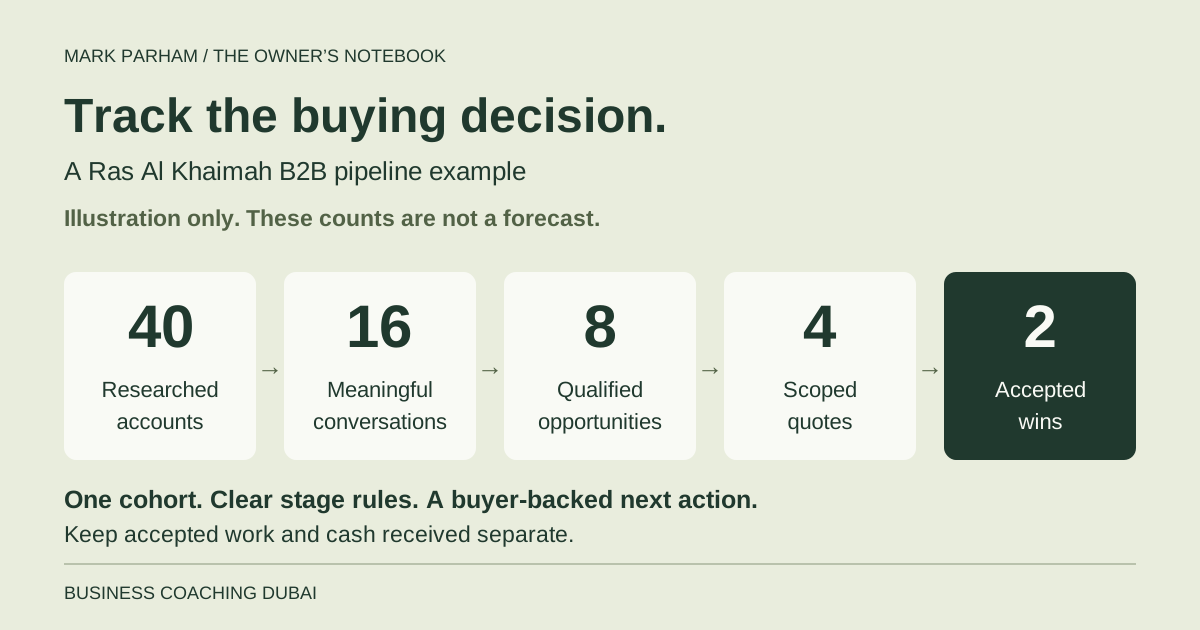
Here is an illustrative batch, not a forecast: 40 researched accounts lead to 16 conversations, eight qualified opportunities, four quotes and two wins. That is a 40% account-to-conversation rate, a 50% conversation-to-opportunity rate and a 50% quote-to-win rate.
The numbers describe different stages. If conversations are scarce, look at account relevance and the route to contact. If conversations happen but opportunities do not, examine the need and fit. If suitable quotes stall, investigate scope, timing, procurement requirements and follow-up before assuming the price is wrong.
Track the same group over an appropriate period. A quote sent yesterday has not failed because it is still open today. Record stage dates, reasons for loss and the cost of the sales effort. Two wins are only useful commercially if the resulting work makes sense to deliver.
Make every follow-up earn its place
At the end of a conversation, agree what happens next, who owns it and when it should happen. That might be sending a specific scope, answering a technical question or checking back after the buyer’s internal review. Record the commitment where someone else can see it.
A follow-up should advance the decision. “Have you seen my last email?” may occasionally be necessary, but it adds little. A clarified assumption, a requested document or a direct answer to the buyer’s concern gives them a more useful reason to respond.
Use the sales follow-up guide to check for gaps. Close the loop when there is no fit or no permission to continue. A tidy pipeline needs honest closed records as much as it needs new enquiries.
Treat advertising as a test with a commercial question
On 13 October 2026, RAKEZ reported a digital advertising workshop covering campaign structure, targeting, budgets and evaluating results for smaller businesses. That is a relevant local discussion, not evidence that a particular platform will produce profitable B2B customers for you.
My view is that advertising becomes easier to judge once you can define a suitable account and track what happens after the enquiry. Set a bounded test and compare qualified opportunities and delivered work, alongside the cost. Clicks and form submissions are intermediate signals.
Use the free pipeline worksheet below to research the first accounts, record what you know and assign the next actions. If you want to work through the weak stage with me, bring that record. I work online from Dubai, so we can examine your Ras Al Khaimah sales process without pretending that more names alone will fix it.
Put this into practice · Free resource
Ras Al Khaimah B2B pipeline worksheet
Open the worksheet, fill in your own examples and print or save your completed copy. No email needed.