 Mark Parham
In this article
A profitable service quotation needs a defined job, complete delivery costs and clear rules for changes. For a small business in Ajman, check access, quantities, equipment, travel, revisions and completion before putting a price at the bottom. A price can look healthy until one unplanned visit removes most of the margin.
This article is about quoting a particular job. It is different from deciding your general pricing model, which I cover in the service pricing guide. Here, the question is whether the promise in this quotation matches the work and cost you have allowed for.
You do not need a complicated estimating system to improve that decision. You need a repeatable way to expose assumptions before the customer accepts them, and a habit of checking the estimate against what actually happened.
Describe what finished looks like
Start with the deliverable. What exactly will the customer receive, in what quantity, at which location and by when? If the job involves a visit, explain what will be done during it and what evidence or handover follows. Avoid words such as “complete service” when the boundaries are unclear.
Then identify what the customer must provide. That could be access, an authorised contact, accurate measurements, agreed materials or approval of an initial version. If a missing input prevents delivery, the quotation needs a practical way to handle it before somebody is waiting on site.
Ask the person who will do the work to review the scope. They may spot an access restriction or a missing preparation task that is invisible from the sales desk. A short discussion before sending the quote can be more useful than a long argument after acceptance.
Make the site assumptions visible
Ajman Free Zone’s sector information covers varied activities and premises, including offices and warehouses. That variety is one reason a universal “Ajman service rate” is not a reliable way to price an individual job. The work, location and delivery conditions matter.
A concrete example appears in its short-term warehouse information, where labour, forklift and cleaning services are described as available at additional cost. The useful quoting lesson is to separate the core service from handling, equipment and clean-up. It is not a price benchmark for your business.
For your own job, confirm whether loading, parking, lifting equipment, security clearance, power or waste removal are relevant and who arranges them. Do not assume every site needs all of these. Ask about the actual job and record the answer, including anything still unconfirmed.
Build the cost from the work
Use a simple cost sheet. Include direct labour, materials, subcontracted work, travel and an appropriate allocation of overheads. Check that the same cost has not been counted twice. If salaried labour is already included elsewhere in your model, be consistent about how you allocate it to the job.
For illustration, suppose the estimated costs are AED 1,800 labour, AED 1,200 materials, AED 600 subcontracted work, AED 200 travel and AED 400 allocated overheads. The total is AED 4,200. These are invented planning figures, not Ajman market rates, and the example excludes taxes and financing costs.
The labour estimate should reflect actual delivery, preparation and handover time. Materials should use the quantities and wastage assumptions relevant to the work. Where a supplier price is uncertain, get an appropriate current quotation rather than hiding uncertainty inside a precise-looking total.
Know the difference between margin and markup
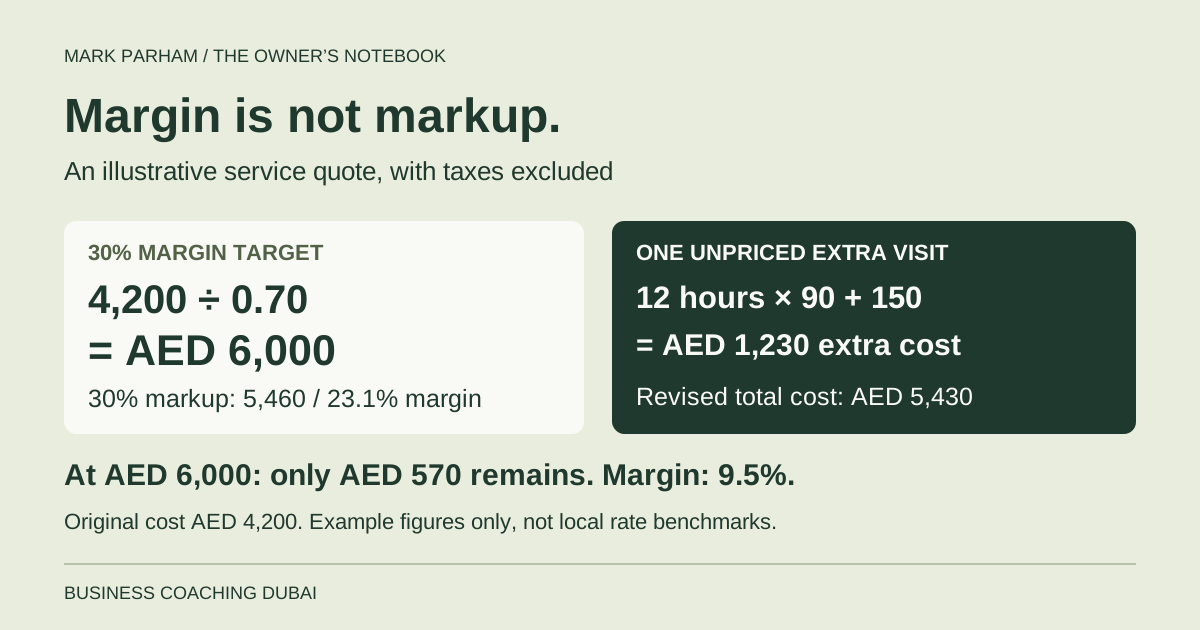
If that AED 4,200 cost is sold for AED 6,000, the amount left after the included costs is AED 1,800. Divide AED 1,800 by the AED 6,000 selling price and the margin is 30%. To calculate a selling price for that margin, divide the cost by 0.70.
Adding a 30% markup gives a different answer: AED 4,200 multiplied by 1.30 is AED 5,460. The remainder is AED 1,260, which is about 23.1% of the selling price. Both calculations are valid, but they answer different questions. Confusing them changes the commercial decision.
This does not mean every job should have a 30% margin. The appropriate target depends on your costs, risk, capacity and market. Also, the remainder is not automatically business-wide net profit. It only reflects the items included in this simplified job calculation.
Price the consequence of one extra visit
Now test a specific failure in the original estimate. Suppose an additional visit creates 12 extra labour hours at an illustrative fully costed AED 90 per hour, plus AED 150 travel. That is AED 1,080 labour and AED 150 travel, adding AED 1,230.
The total job cost becomes AED 5,430. If the selling price stays at AED 6,000, only AED 570 remains after the included costs. That is a 9.5% margin. The sales price has not changed, but the economics of the job have changed substantially.
Do not automatically add an arbitrary contingency to every quote. First ask why the extra visit might happen. Could better information prevent it? Is it customer-requested additional work? Is it correcting your own error? Those situations need different operational and commercial responses.
Separate included work, options and changes
Present the core scope clearly, then identify genuinely optional work separately. If the customer may need an additional visit or extra deliverable, explain how that will be priced or agreed. Do not bury an essential part of the promised result in an optional line to make the headline price look smaller.
Describe the change process in plain language. Who can request a change? Who confirms the impact on price and timing? When must approval be received? The operational aim is to stop extra work beginning while the customer and your team hold different assumptions.
If a change becomes necessary during delivery, record the revised scope and seek the appropriate agreement before proceeding. Do not use this article as a substitute for reviewing contractual wording with a qualified adviser. A useful workflow and an enforceable agreement are related, but they are not identical.
Give the customer a quote they can compare fairly
A customer should be able to see the deliverables, important assumptions, exclusions, timing, payment arrangements and acceptance process without decoding a page of internal cost calculations. You can understand your costs in detail without making every internal estimate part of the sales document.
State any validity period based on the actual circumstances, particularly where supplier costs or availability may change. Make the tax treatment clear using the correct advice for your business; the worked example here deliberately excludes tax rather than assuming one treatment applies to everyone.
When a buyer asks for a lower price, examine scope before simply reducing the total. Could fewer visits, a different turnaround or a smaller deliverable meet the need? Show the change explicitly. A cheaper version should have a clear commercial explanation, not silently contain the same work at a damaging price.
Keep the agreement and the delivery record together
Ajman Chamber’s legal-services information lists quotations, purchase orders, correspondence, invoices and contracts among documents supporting commercial mediation. That does not establish the legal status of your particular quote, but it is a useful reminder to keep a coherent record.
Save the accepted version, the customer’s approvals, relevant site information and any agreed changes together. Make sure delivery staff can see the current scope. A revised quote that lives only in the owner’s messages is a weak basis for handing over the job.
At completion, record what was delivered and any unresolved items. Use the acceptance process appropriate to the agreement. Clear records help you understand the work commercially and make it easier to resolve a misunderstanding without reconstructing weeks of conversations.
Review the estimate after the job
Compare estimated and actual labour, materials, visits and subcontract costs. Separate an estimating mistake from a delivery problem or an approved change. If you simply label every overrun “bad luck”, the next quotation will repeat the same assumptions.
Look for patterns across comparable jobs. Repeated access delays may justify a better pre-visit check. Repeated revisions may mean the brief or approval stage is weak. An unusually difficult one-off job may need its own explanation rather than a blanket price increase.
Use the free job-quotation worksheet below for your next suitable quote. If you want to work through it with me, bring the estimate and one completed job for comparison. We can examine where the money and time actually go, then decide what needs to change before you promise the next job.
Put this into practice · Free resource
Ajman service-job quotation check
Open the worksheet, fill in your own examples and print or save your completed copy. No email needed.