 Mark Parham
In this article
A useful business coach for an Abu Dhabi owner should fit the decision you need to make, the way you want to work and the evidence you can bring. Start there. Then compare experience, session scope, practical terms and whether online or in-person meetings suit the business.
Searching for a business coach in Abu Dhabi can produce a mixture of executive coaching, business advice, training programmes and company-formation services. Each can serve a purpose. They are not interchangeable, and the most impressive-looking website is not necessarily the best fit for the problem on your desk.
I provide online business coaching from Dubai, including for owners in Abu Dhabi. There is no Abu Dhabi office implied by that. This guide is about making a better buying decision and arriving at your first conversation with something useful to work on.
Name the business issue before choosing the service
An established business owner might need to improve sales follow-up, decide whether to add capacity, or reduce the number of routine approvals coming back to them. A founder at an earlier stage might still be working out which customer to serve and which offer to test.
Those are different conversations. Write a brief that explains your stage, the issue and the decision you want to make. Include what you have already tried. If you have no reliable figures yet, say so. Discovering what information is missing can be part of the work.
For example: “We provide B2B services in Abu Dhabi. We are getting enquiries, but I cannot tell whether our problem is poor-fit demand, weak follow-up or pricing. I want to decide what to fix before we spend more on marketing.” That gives a coach something concrete to question. It is much more useful than asking for general growth advice.
Separate coaching from other support available locally
Sometimes the next step is a connection, a technical answer or access to an existing business service. A coaching conversation might help you recognise that, but you should still use the right channel for the actual need.
The Abu Dhabi Chamber's services hub lists services including document attestation, legal consultancy and commercial dispute mediation, with access through its official channels. Check the current service, membership requirements and eligibility directly. The existence of a programme does not mean every business qualifies or that it will solve your particular problem.
If your issue concerns a licence, employment requirement, contract or tax treatment, identify the relevant authority or qualified professional. If your issue is deciding which customer group to pursue, what to delegate or how to review performance, an owner-focused coaching session may be a more appropriate starting point. Make that distinction before you spend.
Decide how the conversation needs to happen
In-person meetings may be valuable when you want someone to see a workplace or observe a team. Online sessions can be practical when the work is about a decision, a set of figures or a process that can be explained on screen.
For an Abu Dhabi owner considering a Dubai-based coach, the relevant question is whether travel adds anything to the work. If the discussion is a review of ten enquiries and three possible changes, a prepared online conversation may be enough. If you need a full operational inspection, be explicit about that requirement and ask who can deliver it.
My first-hour service is an online Google Meet call. You speak directly to me. It is not an on-site consultancy visit, a team workshop or a done-for-you implementation project. Clear expectations make it easier for both of us to use the time properly.
Use a realistic sample, not a perfect presentation
Consider an illustrative service firm with 24 enquiries in a month. Six fall outside its actual service scope, leaving 18 suitable opportunities. Six of those become customers. Its qualified conversion rate is 6 divided by 18, or about 33%. Its total enquiry conversion is 6 divided by 24, or 25%.
The two figures tell different stories. The first helps you examine what happens to suitable opportunities. The second also reflects how well your incoming demand matches the service. Neither figure, by itself, proves that the team is performing well or badly.
Bring a few real examples behind the numbers. Which customers needed an internal approval? Which were comparing a different scope? Which had no recorded next step? These are questions for your own records, not assumptions about every Abu Dhabi buyer. The useful work begins when the sample shows what actually happened.
Ask how the coach will challenge your explanation
A good conversation should leave room for your first explanation to be wrong. If you think the problem is price, what evidence supports that? If you think the team lacks initiative, have they been given clear decision limits? If you think the market is quiet, what has changed in the enquiries you are receiving?
Ask a potential coach how they distinguish observations from assumptions. Ask what they would need to understand before suggesting a change. You do not need somebody to agree with everything you say. You do need to feel that they have understood the business before challenging it.
Also ask what happens when the issue falls outside their scope. A confident answer is not the same as a qualified answer. Somebody who can explain their limits gives you a clearer basis for deciding where their input belongs.
Check experience and terms without filling in the gaps yourself
The International Coaching Federation's consumer guidance highlights experience, training and the working relationship as points to consider. Verify any qualification that is material to your decision, and ask for the context behind claimed results.
Then look at the offer in plain terms. Who takes the call? How long does it last? What preparation is expected? Are written recommendations included? Is there a minimum programme length? What are the cancellation arrangements? These questions are normal purchasing diligence, not an awkward interruption.
My background is as a business owner, property investor and author. The first call is practical coaching and mentoring for a specific business issue. You can read more about me here. If you specifically need an accredited coaching pathway or a particular industry qualification, verify that requirement separately rather than assuming it from a job title.
Define a useful outcome before the meeting
It is easy to end a conversation with a long list of ideas. A better outcome is usually narrower: a decision, an experiment, a missing piece of information to obtain, or a process to change.
For the example above, the outcome might be to assign a named owner and next-action date to every suitable enquiry for two weeks, then review the results. That is a testable operational change. “Be more proactive with sales” is too vague to tell whether anything happened.
Make the implementation practical. Name the person responsible, the first action, the review date and the evidence you will look at. If your team is already overloaded, decide what they will stop or simplify to make room. A plan that ignores capacity is unlikely to survive a busy Monday.
Prepare a one-page first-call brief
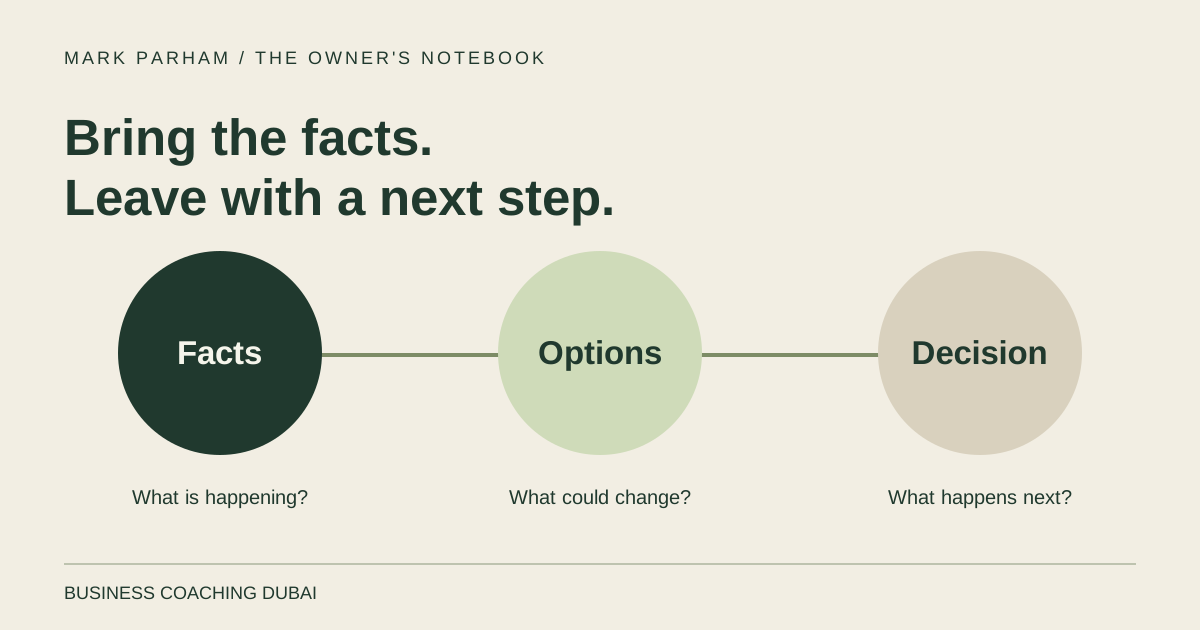
The worksheet below has space for your business stage, the problem, three facts, three assumptions and the decision you want to make. It also asks what you have tried and which constraints must be respected.
Keep confidential customer details out of the brief unless they are genuinely needed. You can normally describe a sales or management problem using anonymised examples. The aim is to make the conversation clear, not to assemble a complete company archive.
For ongoing reviews, use the 15-minute weekly owner review. If the issue is responsibility, read the guide to delegating decisions with clear boundaries. Those can help you choose the one issue most worth discussing.
What working with me looks like
Your first 60-minute call is AED 1,000, against my usual AED 2,500 hourly rate. It is one payment, with no subscription. We focus on a real issue in your business and agree practical next actions. Any further coaching is discussed separately.
The first call carries my money-back guarantee. If you are unhappy at the end of the attended call, tell me then and I will refund the full amount. The booking terms explain the guarantee, cancellation and rescheduling arrangements.
If that fits what you need, bring the issue. You do not need a polished presentation, and you do not need to have the answer already. You do need to be willing to look at the facts and do something with the discussion afterwards.
Put this into practice · Free resource
Your one-page first-call brief
Open the worksheet, fill in your own examples and print or save your completed copy. No email needed.