 Mark Parham
In this article
To price a service business in Dubai, start with delivery costs and realistic capacity, then test whether the scope and value justify the price to the customer. A competitor's number can provide context. It cannot tell you what your own business can afford to deliver.
A full diary is not the same thing as a profitable business. You can sell every available slot and still leave too little money after the work is done. The problem may be your price, the amount of work included, the way you deliver it, or a combination of all three.
I would work through the numbers before deciding you simply need more confidence to charge more. Confidence helps you explain a sound price. It does not repair a price built on missing costs.
Describe the job before costing it
Choose one service you sell regularly. Write down exactly what the customer receives, the delivery deadline, the information they must supply, and the number of revisions or visits included. Include handover and aftercare if you provide them.
Now compare that description with three recently completed jobs. Did the actual work match the promised scope? Were there extra meetings, repeat visits, late changes or time spent chasing information? A price that works for the written offer may fail when the real delivery is much larger.
For a Dubai service business operating across different locations, include the actual travel and access arrangements relevant to that job. Do not assume every hour away from the desk is productive delivery time. Use your records rather than a general claim about what working in Dubai must cost.
Separate monthly costs from costs created by each job
Some costs continue whether you complete ten jobs or twenty. Others arise because you take on a particular piece of work. Keeping these separate helps you understand what each sale contributes and what the business needs to cover overall.
In the example below, assume monthly fixed operating costs of AED 24,000. That includes the salaries, owner pay and overheads assigned to this simplified business. Each job then creates AED 900 of additional external delivery costs. Do not add the same salaried labour again as a per-job cost.
Your own model might use a different split. A contractor paid only for each job belongs in a different place from a salaried team member whose cost continues through a quiet week. Check that every relevant cost is included once. These examples exclude taxes and financing costs and are illustrations, not Dubai market benchmarks.
Use a realistic number of jobs
Suppose the business can complete 20 equivalent jobs in a normal month. Allocating AED 24,000 of fixed costs across those jobs gives AED 1,200 per job. Add the AED 900 variable cost and the allocated cost is AED 2,100.
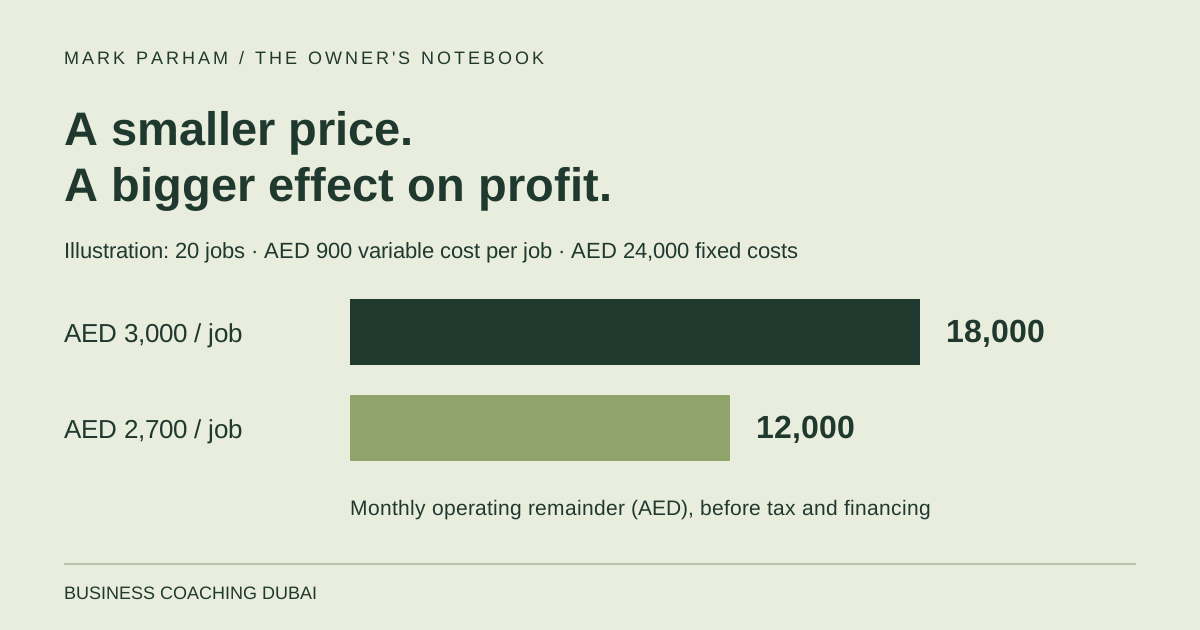
If you charge AED 3,000, that leaves AED 900 per job after the allocated costs. Across 20 jobs, revenue is AED 60,000. Variable costs total AED 18,000 and fixed costs remain AED 24,000, leaving AED 18,000 before the excluded items.
The important assumption is the 20 jobs. It needs to reflect the time spent selling, managing, taking leave, doing administration and correcting work. Dividing overheads by a theoretical maximum can make a fragile price look comfortable. Use completed jobs from a representative period, then test a quieter month.
Check what happens when capacity is not fully sold
At 16 jobs, with the same AED 3,000 price and AED 900 variable cost, revenue falls to AED 48,000. Variable costs fall to AED 14,400. Fixed costs still total AED 24,000. The remaining amount is AED 9,600.
That is why an allocated cost is not a permanent truth about the service. The fixed cost per job rises when fewer jobs are completed. In this example it becomes AED 1,500, and the full allocated cost becomes AED 2,400.
You can also calculate the contribution from each additional job: AED 3,000 minus AED 900 equals AED 2,100. Divide AED 24,000 by AED 2,100 and you get about 11.43 jobs to cover fixed costs. As jobs are whole units here, you need 12 equivalent jobs. That calculation assumes the costs and capacity remain valid at that volume.
Test the discount before offering it
Now imagine reducing the price by 10%, from AED 3,000 to AED 2,700, while completing the same 20 jobs. Revenue becomes AED 54,000. The delivery and fixed costs have not changed, so the remaining amount falls from AED 18,000 to AED 12,000.
A 10% price reduction has cut this example's operating remainder by a third. You would need more jobs to recover the difference, and more jobs may require capacity you do not have. This does not mean every discount is a mistake. It means the discount needs a business case.
If a customer has a lower budget, look at the scope before changing only the price. Could you remove a deliverable, reduce visits or change the turnaround? A smaller, clearly defined service may be more sensible than promising the original service at an uneconomic price.
Costs set a constraint; customers still decide whether to buy
A cost calculation tells you what the business needs. It does not force the customer to value the service at that amount. You still need to understand the customer's problem, the alternatives and the reasons they might choose you.
The Australian government's general pricing guide describes using costs, customer research and competitive context together. Its commercial principles are useful here; its Australian legal and tax details are not UAE rules.
When comparing alternatives, compare the scope too. A quote including ongoing support cannot be judged only against one that ends at handover. Ask customers what they actually need and which parts they value. Then explain your offer clearly enough for them to make a fair comparison.
Choose a pricing model that fits the work
Hourly pricing can be useful when the amount of work is uncertain and the customer understands how time will be recorded. Fixed-price work can suit a repeatable, well-defined result. A retainer can suit a continuing need, provided both sides understand what is included and what happens when the demand changes.
No model removes the need to understand delivery. A fixed-price project with unlimited revisions can become a problem quickly. A retainer with unclear availability can create expectations your team cannot meet. An hourly arrangement can still lose money if too much work goes unrecorded.
Start with the work customers buy repeatedly and the uncertainty you can reasonably manage. Write down the scope, exclusions, approval points and change process. Have the appropriate professional review contractual or tax questions where needed. The commercial decision and the legal wording are related, but they are different tasks.
Run a small, comparable pricing test
Rather than changing every offer at once, choose a clearly defined service or a new-customer cohort. Record the scope, quoted price, customer fit, decision, delivery hours and actual additional costs. Keep the comparison consistent enough to learn from it.
Do not judge the change from one enthusiastic buyer or one rejection. Look at why people accepted or declined and what happened during delivery. A higher quoted price that creates much more unpaid support may not improve the business. A lower conversion rate can still be commercially acceptable if the resulting work is healthier, but you need the figures to tell.
Keep an eye on the follow-up process as well. If nobody records the reason a quote went quiet, you may blame price for a problem elsewhere. Pricing decisions become more useful when sales and delivery records can be read together.
Use the worksheet with your own numbers
The downloadable worksheet below gives you a place to record monthly fixed costs, variable cost per job, price, realistic job volume and a quieter-month scenario. It includes the worked example and blank rows for your assumptions. Open it in your browser, fill in your own assumptions and print or save your completed copy.
Check every assumption before treating the result as a decision. Are you counting the same labour twice? Is owner pay included? Are all jobs comparable? Have you allowed for the capacity needed to fulfil the promise? The worksheet makes the questions visible; it cannot answer them for you.
Once you can explain the price, the scope and the delivery economics on one page, you are in a better position to decide what to change. That is the discussion I would want to have before telling you to charge more.
Put this into practice · Free resource
Service pricing and capacity worksheet
Open the worksheet, fill in your own examples and print or save your completed copy. No email needed.