 Mark Parham
In this article
More repeat customers come from delivering the promised result and making the next relevant purchase easy. For a service business in Fujairah, separate residents, returning visitors and business accounts. Each has a different reason and timetable for returning. A monthly discount message to everyone is not a retention strategy.
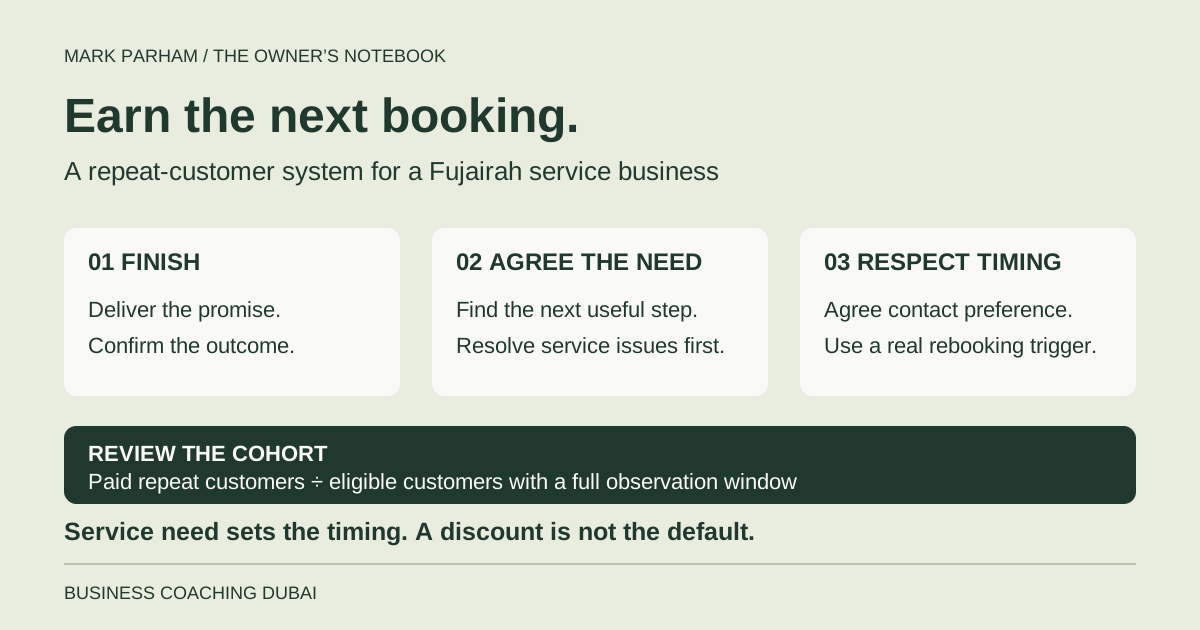
I would start with the customers you have already served. Which ones could reasonably need you again? What would that next need be? Did the first job leave them comfortable enough to choose you a second time? Those questions come before a loyalty scheme or another marketing subscription.
A repeat purchase is not always the right outcome. Some jobs solve a one-off problem. Some visitors may not return to the area for years. You can still deliver excellent service without pretending every customer belongs in a recurring sales sequence.
Separate three different kinds of return
A resident using a routine local service may return when the same need arises again. A visitor may return for another occasion or a different experience. A business account may reorder according to operating requirements, an agreed schedule or a procurement process. Put those groups in separate rows before planning follow-up.
There is a real local reason to make that distinction. Fujairah Tourism’s Al Aqah information describes hotels and resorts alongside activities, dining, pools, diving and snorkelling. Those experiences can create different return occasions from a household’s recurring service needs.
Meanwhile, the Port of Fujairah’s overview identifies activities including ship supplies and services, oil storage and trading, and aggregate export. These are examples of a different business context, not a claim that your service automatically fits port customers or that contracts are available.
Make the first job easier to trust
Before asking someone to return, examine what the first experience felt like. Was the scope clear? Did they know when you would arrive or respond? Were changes explained before they became surprises? Did the handover confirm what had been completed and what remained outstanding?
Choose one repeated source of uncertainty and fix it. For a scheduled service, that might be a clear confirmation with the agreed window and contact point. For project work, it might be a handover that explains the result in terms the customer understands. The right improvement depends on the service.
Do not confuse a friendly team with a reliable process. Friendly people can still leave customers chasing updates. Record the promise, the person responsible and the next communication point. If customers must repeatedly ask what happens next, you have a practical retention problem to investigate.
Find the next genuine need
At completion, ask whether there is a sensible next step. A routine service may have a recommended review interval based on the actual work and professional guidance. A business account may have a known reorder cycle. A visitor may prefer to hear about a suitable experience when planning another trip.
Fujairah Tourism’s watersports page describes activities including cruises, private charters, snorkelling and diving courses at different levels. My commercial interpretation is that a next visit can involve a relevant new occasion rather than repeating exactly the same purchase.
That is not a recommendation to push a customer into an activity they are not suited or qualified for. The operator must assess suitability and requirements. The wider business lesson is to understand the next need, explain the appropriate options and let the customer choose.
Agree the timing and channel
If follow-up would be useful, ask how and when the customer would like it. A specific invitation is clearer than a vague promise to “keep in touch”. For example, you might agree to contact them shortly before a known service review or when they are considering a return visit.
Record the preference and respect it. A phone number supplied to arrange a job should not automatically become permission for unrelated marketing. Use the applicable rules and your actual consent arrangements, and stop when someone asks you to. This is a practical retention plan, not legal advice about messaging requirements.
Keep the information proportionate. You may need the previous service, the relevant next occasion, a contact preference and the agreed date. You usually do not need a detailed personal profile. Store customer information appropriately rather than scattering it across private notes and multiple staff phones.
Give the next message a clear purpose
A good follow-up makes the customer’s decision easier. It could confirm that an issue was resolved, remind them of an agreed review or answer a question left open at handover. Explain why you are contacting them and make the next step straightforward.
For a business account, use the agreed contact and purchasing route. The person who received the service may not be authorised to place another order. Clarify that during the relationship so a helpful reminder does not turn into an awkward attempt to bypass the buyer’s process.
For visitors, do not assume a weekly message is welcome simply because the first experience went well. Their next occasion may be seasonal, event-led or unknown. Where they want further information, keep it relevant to the interest they expressed and the frequency they agreed.
Resolve dissatisfaction before selling again
If the customer is unhappy, the next task is to understand and address the issue. Do not send an upbeat rebooking offer while an unanswered complaint sits elsewhere in the business. That tells the customer your sales process and service process are not speaking to each other.
Give someone responsibility for the response. Confirm what is understood, what will be checked and when the customer can expect an update. Keep the promise realistic. If you cannot deliver the requested resolution, explain the position clearly rather than making another promise the team cannot fulfil.
After the issue is handled, check the process that caused it. Was the original scope unclear? Did information disappear during handover? Was the appointment accepted without enough capacity? Fixing that cause can matter more to future retention than adding another reward to a loyalty programme.
Measure customers who were actually due to return
A simple repeat-customer percentage can mislead if it mixes very different buying cycles. Someone who purchased yesterday has had little chance to return. A visitor with no planned trip should not be treated like a business account whose next service date has passed.
For an illustrative cohort, suppose 40 customers had an agreed or reasonably expected need during a defined review window. If 12 bought again in that window, the repeat rate for that cohort is 30%. Define the group and dates consistently before comparing it with another period.
If the next comparable group has 16 repeat customers out of 40, the rate is 40%. That is an increase of ten percentage points, not proof that one reminder caused the improvement. Customer mix, service quality, timing and other factors may have changed. Record what you know and what remains uncertain.
Check the economics before offering a reward
Suppose, as an example, a service sells for AED 500 and creates AED 300 of direct incremental delivery costs. It contributes AED 200 towards fixed costs and profit. A 10% discount reduces the price to AED 450 and that contribution to AED 150, assuming delivery costs stay the same.
The contribution has fallen by 25%. Across 12 jobs, it falls from AED 2,400 to AED 1,800. These are illustrative figures excluding taxes, not local market prices. A discount might still make commercial sense in a particular situation, but it needs a reason beyond “loyal customers expect one”.
Consider convenience first. Clear rebooking, consistent service records and a suitable appointment can be valuable without reducing the price. Do not promise priority slots or extras your capacity cannot support. A reward that disappoints the customer can undermine the relationship it was meant to strengthen.
Run one small retention experiment
Choose a customer group with a genuine next need and a suitable contact permission. Fix one part of the experience, record the expected return window and assign the follow-up. Review repeat purchases alongside complaints, delivery effort and the commercial contribution of the work.
Use the free customer-return worksheet below to make that plan visible. Keep completed, waiting and no-longer-relevant records distinct. The weekly owner review is a useful place to check whether agreed customer actions are being completed.
If you want to work through it with me, bring a small set of anonymised examples and the process you currently use. I coach online from Dubai and can help you examine the decisions in your Fujairah business. Start with a better reason for customers to return, then make acting on it easier.
Put this into practice · Free resource
Fujairah customer-return worksheet
Open the worksheet, fill in your own examples and print or save your completed copy. No email needed.