 Mark Parham
In this article
A useful 90-day growth plan for a small business in Sharjah starts with one commercial goal, a realistic capacity limit and a weekly decision. Spend the first month finding evidence, the second repeating what works, and the third deciding what deserves more time or money. A longer to-do list is not a growth strategy.
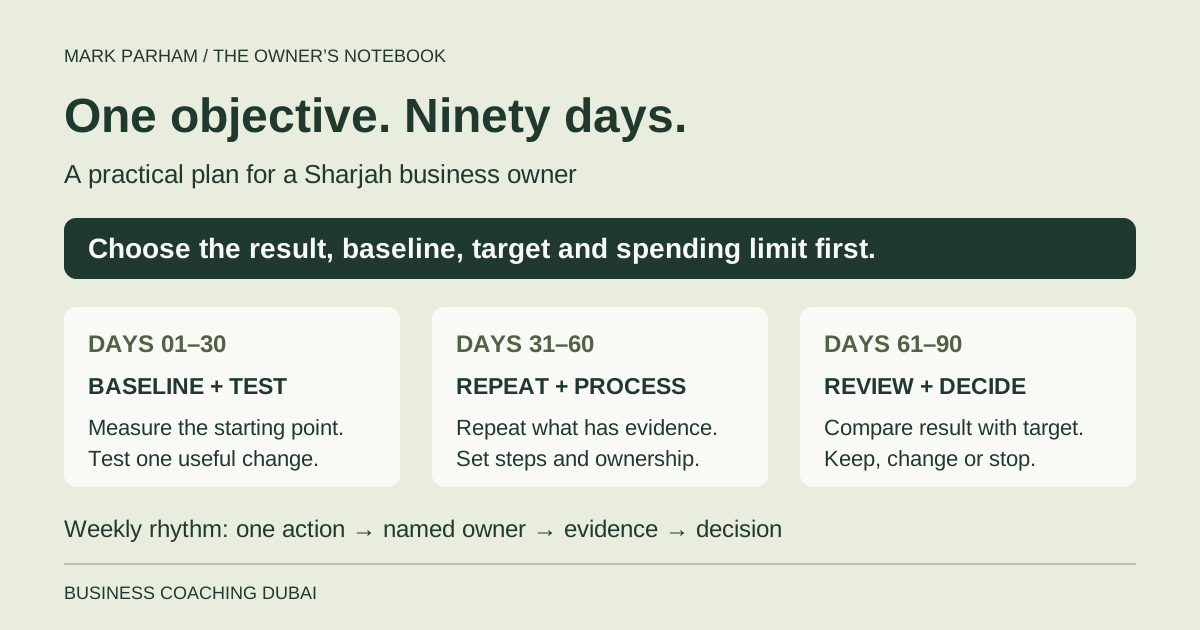
“We need to grow” can mean more sales, better jobs, healthier cash flow or less dependence on the owner. Those are different problems. If you put them all into the same quarterly plan, the team can stay busy for three months without knowing whether the business improved.
I would start with the trading business you have today. What do customers already buy? Where does delivery become difficult? Which part of the operation is holding back the next sensible step? Answer those before buying software or adding another marketing channel.
Write the result before choosing the activities
Choose a result you can describe in one sentence. For example: “By the end of the quarter, we want four additional recurring business customers for our existing maintenance service, without increasing missed appointments.” This is an illustrative target, not a forecast for a Sharjah company.
The second half matters. Growth that creates delivery failures can damage the customers you already have. Put a quality or capacity condition beside the sales goal. You might track jobs completed when promised, customer issues left unresolved or owner hours spent correcting work.
Decide what you will not pursue during these 90 days. A new service, another emirate and a complete website rebuild may all be reasonable projects. They cannot all be the priority for a small team with a full diary. Keep a separate list and revisit it at the next planning point.
Use the first week to establish the starting numbers
Take a recent, representative period and record enquiries, suitable enquiries, quotes, accepted quotes, completed jobs and repeat orders. Add the time and costs needed to deliver the work. If the records are incomplete, say so and start collecting them rather than inventing a tidy baseline.
Separate customer types. A one-off household job and a recurring business account can have very different sales cycles and delivery demands. Combining them in one average may hide the opportunity. Start with the segment that fits your capacity and has a problem you can already solve well.
Also look at cash timing. An accepted quote is not cash in the bank, and a large order can create costs before payment arrives. Write down the commitments the growth experiment would create. The aim is to understand the working demands, not to turn this worksheet into professional financial advice.
Check whether the goal fits your available hours
Suppose, for illustration, each new recurring customer needs six delivery hours a month. Four customers would require 24 hours. If you genuinely have 32 spare delivery hours after existing commitments, the plan leaves eight hours for variation. That is a starting capacity check, not a promise that the work will fit.
Now include account setup, travel, reporting and customer questions. If those activities use another ten hours, the original plan no longer fits the 32 available hours. You must change the scope, timing, target or capacity. Hoping the team will somehow manage is not a capacity plan.
Do the same for the owner. If every new customer requires you to approve each routine decision, sales growth may simply lengthen your queue. The five-day owner bottleneck audit helps you find dependencies before they become a bigger problem.
Days 1–30: test one route to one customer group
Choose a small experiment with a defined offer, audience, owner and review date. That could be discussing an existing service with a handful of suitable business accounts, improving the follow-up on recent quotes or testing a clearer version of a service customers already request.
Record the assumption you are testing. “These customers need a dependable monthly service and understand this scope” is more useful than “we should post more”. Decide what evidence would support the assumption and what would make you change it. Conversations and delivery records may be more informative than clicks.
Keep the experiment small enough that a disappointing result is affordable. Set the time allowance and spending limit before starting. Do not add three new channels halfway through because the first week feels quiet. Allow enough time for the type of buying decision you are testing, then review what actually happened.
Use Sharjah support to solve a named problem
There are local support options worth investigating, but joining a programme is not itself the commercial goal. Sheraa’s membership information describes support from early ideas through growth-stage SMEs, including advisory sessions, workshops and connections. Benefits depend on the founder’s stage, and applications are reviewed.
If your plan exposes a specific gap, such as a weak route to customers or an unresolved operating question, that gives you a better reason to seek support. Check the current eligibility, terms and relevant offering directly. Do not assume an introduction, acceptance or funding will follow from an application.
The Sharjah Chamber’s Tijarah 101 initiative describes offices and facilities supporting entrepreneurs and SMEs, alongside commercial cooperation. That may be worth exploring when workspace or connections are a real constraint. It is not a reason to add overhead before you have tested demand.
Days 31–60: turn evidence into a repeatable process
At the first monthly review, sort the evidence into what worked, what failed and what remains unclear. A customer saying the idea sounds interesting is different from accepting a quote. An accepted quote is different from a completed job that met your cost and quality assumptions.
If the experiment has enough evidence to continue, document the few steps that made it work. Who qualifies the enquiry? What information is required before quoting? Who confirms delivery? Where is the next action recorded? Give each step an owner so the process can survive a busy week.
If the result was poor, change the relevant assumption. Perhaps the service fits a different customer group, the scope is confusing or the sales cycle is longer than expected. Avoid declaring the whole market “bad” from a handful of conversations. Equally, do not keep spending just because the plan originally said 90 days.
Run a short weekly review with a decision at the end
Use the same measures each week: progress towards the target, the delivery condition, costs committed and the next action. Note changes in customer mix or unusual jobs so that a movement in the numbers is not mistaken for a general trend.
Each review should produce a decision: continue, adjust, stop or remove a blockage. “Everyone needs to try harder” is not a decision. “We will shorten the quote turnaround by assigning a named reviewer and checking five cases next Friday” gives the team something they can do.
Keep the meeting brief and put detailed problem-solving elsewhere. The weekly owner review provides a simple rhythm. The point is to see the same business clearly over time, rather than create a fresh dashboard whenever the figures disappoint you.
Days 61–90: decide what deserves the next quarter
Review the full result, including delivery effort and customer experience. If you won the four accounts but they require much more support than expected, the sales target alone does not prove that expansion is sensible. Update the scope and cost assumptions before repeating the offer.
For a locally grounded review prompt, the Sharjah Excellence Award’s SME criteria include strategic planning, marketing, innovation, risk management and business results. Those are useful areas to question. The worksheet here is my practical planning framework, not an official award assessment.
Finish by choosing what to repeat, what to stop and what still needs testing. Write the evidence beside each decision. A good quarter can include rejecting an expensive idea early. You want a stronger business and better decisions, not a report in which every experiment is labelled a success.
Put your next 90 days on one page
Use the free worksheet below to record the starting position, one customer group, one result, your capacity limit and the three monthly checkpoints. Give the first action a name and a date. Leave room to change the plan when the evidence changes.
If you want to work through it with me, bring your figures and the decisions you are avoiding. I am based in Dubai and work online with owners in Sharjah. A focused discussion is much more useful when we can examine an actual choice instead of a general wish to grow.
Put this into practice · Free resource
Sharjah 90-day growth plan
Open the worksheet, fill in your own examples and print or save your completed copy. No email needed.