 Mark Parham
In this article
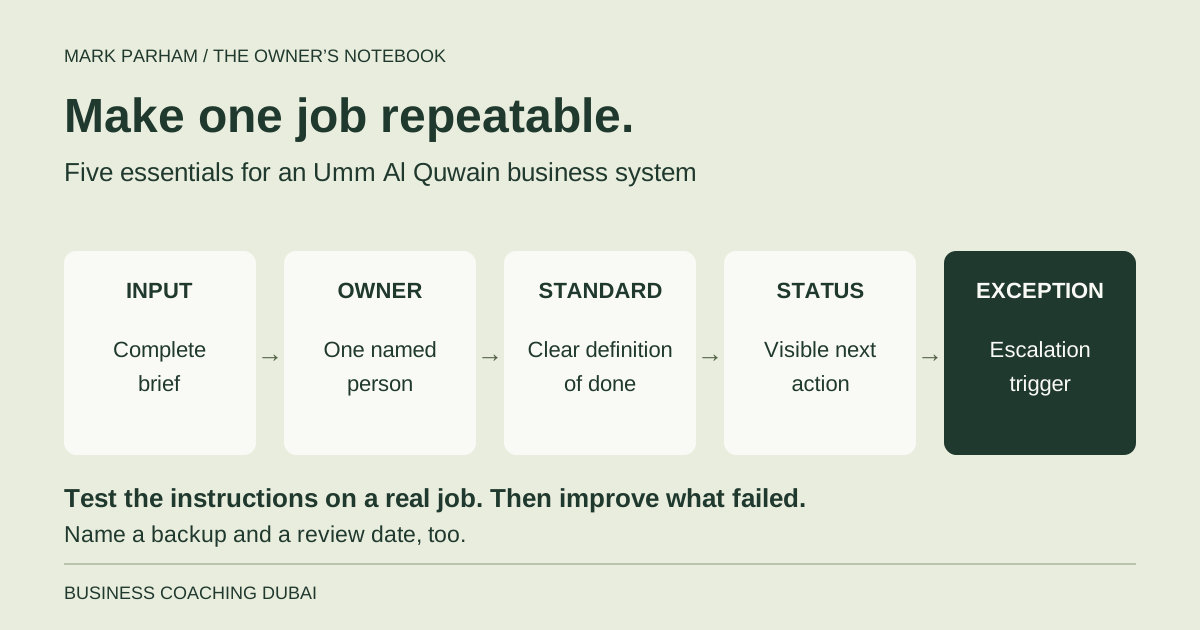
A useful small-business system in Umm Al Quwain tells someone what starts the job, who owns it, what good work looks like and when to ask for help. Start with one recurring job that causes avoidable chasing. Make the process visible, test it with the person doing the work and improve it before buying more software.
If you have to remember every customer promise, your memory has become part of the operating system. It might work while the business is quiet. On a busy day, an incomplete brief, an unanswered supplier question and a missing approval can all land back with you.
I would not begin by writing a company handbook. I would choose one job that happens often enough to test this week. Getting an enquiry into a confirmed booking, preparing a customer order or handing completed work over for invoicing would all be sensible candidates.
Choose the handover that keeps breaking
Look at the last few occasions when work stopped. Where did someone need information that another person already had? Where did a customer believe something had been agreed but the delivery team had never seen it? That handover is usually a better starting point than the neatest department name.
Choose a process with a clear beginning and end. “Improve operations” is too broad. “Take an accepted quote through to a confirmed delivery date” is something you can follow. Name the customer or colleague who receives the output, because their needs help define whether the process worked.
Check frequency and consequence together. A daily irritation may deserve attention, but a less frequent mistake that commits you to an impossible deadline could matter more. Keep the first improvement small enough to test without disrupting the whole business.
Give the job a complete starting brief
A process cannot compensate for missing information forever. Decide what must be known before the job starts: customer reference, agreed scope, delivery location, required date, contact person and any necessary approval. Choose the fields that your actual work requires, rather than copying a long form.
For an illustrative local supplier, “deliver the usual order” is not a complete instruction. The person arranging it needs the item or service, quantity, destination, access conditions and agreed timing. If the customer changes the destination, that change needs to reach the person planning delivery.
Create an incomplete status. It is better to mark a job “waiting for delivery details” than let it sit in a list called “in progress”. Assign someone to obtain the missing information and give that action a date. Otherwise, the status becomes a polite name for forgetting.
Use the local business context without assuming every firm works alike
UAQ Free Trade Zone’s facilities information describes offices for professional services alongside warehouse options for storage, logistics and distribution. That is useful context for thinking about handovers between an office and the place where work is fulfilled. It does not mean every business needs the same system.
For example, a business coordinating goods needs different handover information from a professional service delivering a report online. The goods business may need a packing check and delivery confirmation. The service firm may need an agreed brief, review deadline and approved final version.
If your Umm Al Quwain business serves customers in other emirates, include the actual destination and service commitment in the record. Do not assume a journey, collection or site visit can fit merely because a slot looks empty. That is an operating decision to check with your team, not a universal travel allowance.
Name one owner for the next result
Several people can contribute, but one person should own the next promised result. “The office will sort it” leaves everybody room to assume somebody else has acted. “Sara confirms the delivery slot by 3pm” is clear. The name here is an illustrative role, not a story about a client.
Ownership also needs access. Can that person see the agreed scope? Can they contact the customer? Can they resolve an ordinary scheduling problem? Giving someone responsibility while keeping every tool and decision with you creates more chasing, even if the organisation chart looks tidy.
Agree a backup for absence. The backup needs to find the current position without searching through a colleague's private messages. A shared record should contain the business information needed to continue the work, with access limited appropriately. It does not need every conversation anyone has ever had.
Describe done in terms someone can check
“Make sure it is right” sounds reasonable until two people disagree about what right means. Write a short completion standard. For a confirmed booking, that might mean the customer has the date, scope and contact details, and the delivery team has the same information.
For an order, the completion standard might include checking the agreed quantity, recording any approved substitution and obtaining confirmation of receipt. For a report, it might mean the required sections are present, figures have been checked and the agreed recipient has received the final version.
Keep the checks proportionate. Three useful checks that people actually perform beat twenty boxes they tick without looking. Where specialist, safety or regulated work is involved, use the relevant qualified person's requirements. A simple business worksheet does not replace those standards.
Make the next action visible
You need to know the next action, its owner and the date it is due. A spreadsheet can do this for a small volume of straightforward jobs. An existing CRM or job system may already do it. The important thing is that the team knows which record is authoritative.
Suppose an illustrative business has twelve accepted jobs. Four are waiting for customer information, five have confirmed dates and three need a supplier response. A single “twelve jobs booked” total hides the problem. Those three groups tell you where to act and which promises remain provisional.
Keep the record current at the moment work changes. Updating everything on Friday from memory produces a historical report, not a working system. Ask the team what makes updating awkward. If recording a two-minute action takes ten minutes, simplify the record before demanding more discipline.
Decide which exceptions need you
Write down the circumstances in which the normal process stops. A request outside the agreed scope, an uncertain delivery commitment or a proposed expense beyond someone's authority may need a decision. State who makes it and what information they need to respond.
A useful escalation says: “The customer has requested this change. Here is the effect on cost and timing. These are the options, and this is the decision needed by Thursday.” That lets you make a decision. “There is a problem with the job” simply hands you another investigation.
Do not make every exception wait for the owner. Agree routine decisions people can take within clear boundaries. The companion article on leading a small team in Al Ain shows how to discuss those boundaries without checking every task yourself.
Test it on real work before calling it finished
Follow one ordinary job and one awkward job through the proposed process. Ask the person doing the work to use the instructions while you observe. If they have to ask you what a field means, improve the wording. If an important step happens outside the record, decide whether it belongs inside.
Record the time spent chasing missing information and the number of preventable handover errors. Compare like-for-like work, and note if the sample is small. One smooth job does not prove the system works for every customer, but it can show whether the next test is worthwhile.
Keep a named owner and a review date on the process itself. When the work changes, the instructions need to change. An old document that nobody trusts creates another place to check. Retire superseded versions so the team is not choosing between three competing instructions.
Build one system that survives your absence
Use the worksheet below to describe one recurring job. Fill in its starting information, owner, completion standard, status, exception rule and backup. Then ask the person who will use it what you have missed. Their answer is part of the design.
If the bigger issue is that every decision still reaches you, start with the owner bottleneck audit. The audit finds the dependency; this worksheet turns one recurring piece of work into a process somebody else can run.
I am based in Dubai and work online with business owners in Umm Al Quwain. If you want to work through a real handover with me, bring an example of the job, the current instructions and the point where it usually gets stuck. That gives us something concrete to improve.
Put this into practice · Free resource
One-job business system worksheet
Open the worksheet, fill in your own examples and print or save your completed copy. No email needed.