 Mark Parham
In this article
Leading a small team in Al Ain becomes easier when people know which decisions they can make, what standard matters and when you want an update. Agree those boundaries before handing over work. Then review evidence and coach the person through a specific difficulty, instead of checking every task as it happens.
There is an uncomfortable point in a growing business where the owner is both frustrated by interruptions and reluctant to let anyone decide anything. The team learns to ask first. The owner takes those questions as proof that the team cannot work independently. Everybody gets stuck.
I would start by looking at the arrangement, not labelling the people. Have you explained the result? Have you given them the information and authority to achieve it? Do they know which mistakes they can correct themselves and which situations require an immediate conversation?
Separate a missing skill from a missing decision
If someone asks you to approve a routine customer response, find out why. They may not understand the policy. They may lack product knowledge. They may know exactly what to do but believe you will criticise them for acting without permission. Each problem needs a different response.
Training helps when the skill is missing. A clear boundary helps when authority is missing. Better access helps when information is missing. Repeating “use your initiative” will not fix any of those unless the person knows what initiative is allowed to look like.
Ask for a recent example. What happened, what did they know, what decision did they consider and what stopped them? You are trying to understand the working conditions. Avoid turning the conversation into a test in which they have to guess the answer you have already decided is correct.
Make leadership relevant to the work in Al Ain
The Abu Dhabi Chamber’s July 2025 Al Ain initiative described engagement with small enterprises in retail, tourism and agriculture. Those settings involve different customer requests and team responsibilities. The leadership method here is my practical framework, not a claim about the performance of businesses the Chamber visited.
For a small business, the useful question is which customer promise your team is responsible for delivering. A service team attending premises needs clarity about arrival, access and the work agreed. A customer-facing team needs clarity about what it can promise when a request falls outside the normal offer.
Use the languages and formats your colleagues can work with confidently. Ask someone to explain the agreement back in their own words. A polite nod is not evidence that a complicated instruction was understood. A worked example often reveals uncertainty more effectively than another paragraph of policy.
Where the actual gap is digital capability, the Chamber’s SME Upskilling Programme is one option to investigate. Its Arabic and English learning covers digital tools, productivity and related skills. Companies in Al Ain can apply subject to the stated Abu Dhabi registration and valid Chamber membership requirements. Check current availability; training access is not automatic.
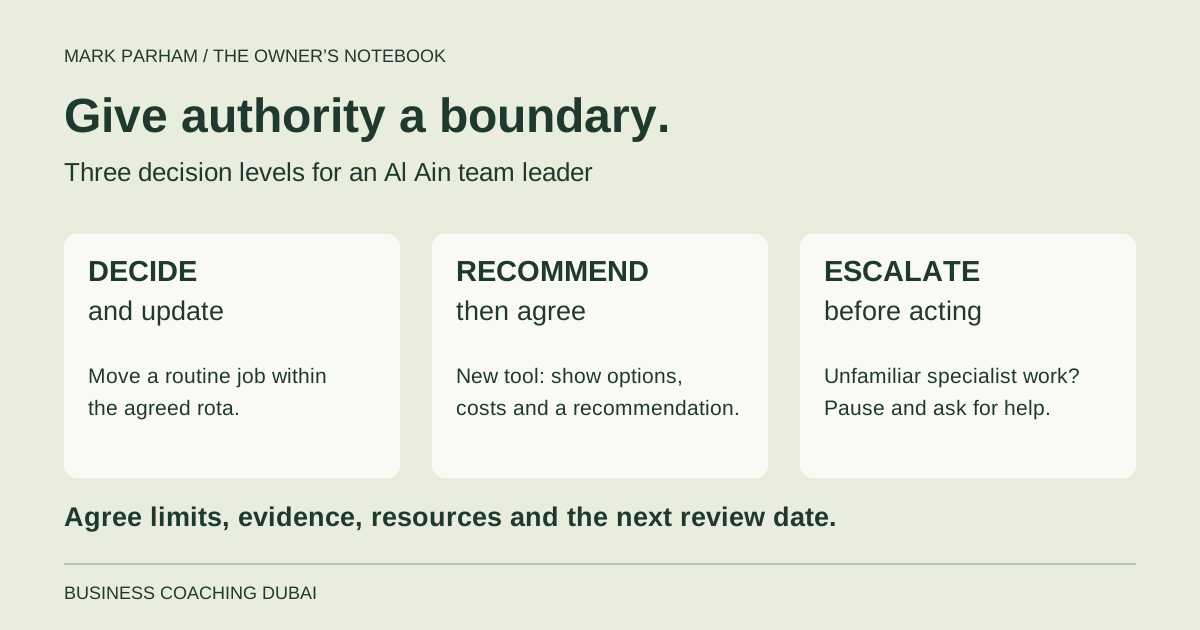
Agree three levels of decision authority
First, identify decisions the person can make and then record or report at the agreed time. These should be routine choices within a clear boundary. For example, rearranging the sequence of already agreed tasks may be fine if it does not change a customer commitment or introduce a safety issue.
Second, identify decisions where you want a recommendation before agreement. A change to scope or a commitment of additional resources might sit here. Ask for the options, the likely consequences and the person's preferred choice. That develops judgement while keeping the approval where it belongs.
Third, identify situations where work must stop or be escalated promptly. Define these for your actual operation, including relevant safety, specialist or customer-risk requirements. Do not use a generic worksheet to weaken professional standards or tell someone to act beyond their competence.
Use a real customer request to test the boundaries
Imagine a small service business, purely as an example. A customer asks for an appointment to move from 10am to 11am. If the agreed work, travel plan and other customer commitments still fit, the team leader may be authorised to confirm the change and update the record.
Now imagine the customer also asks for an extra task. That may affect scope, price and capacity. The team leader prepares a recommendation rather than quietly adding it. If the request involves unfamiliar specialist work, it is escalated before a promise is made.
The distinction is the effect of the decision, not whether the customer sounds impatient. Walk through several examples together. Write down what changes the category. If you disagree, resolve that before the next live customer request forces a rushed answer.
Hold a short conversation with a useful structure
A weekly conversation can cover four questions: what went well, where did work become difficult, what decision needs attention and what support would help? Ask for examples. “Everything is fine” and “the team is struggling” are both too broad to act on.
Look at the relevant evidence together. That might be incomplete handovers, promised completion dates, a customer's actual request or time spent waiting for approval. Keep the discussion close to work the person can influence. There is little value in judging them against a number they cannot affect.
Finish with one or two agreed actions, the responsible person and a review date. If you promised to provide training or remove an obstacle, that action belongs on your list too. Leadership loses credibility when only the employee's commitments get checked the following week.
Give feedback that changes the next attempt
Describe the behaviour you observed and its effect. “The changed appointment was not recorded, so the delivery team used the old time” gives someone a specific issue to correct. “You need to communicate better” leaves them guessing which part of their day you mean.
Ask what happened before prescribing the solution. Perhaps the record was unavailable, the update field was unclear or the person misunderstood who owned the change. You may still need to address a missed responsibility, but understanding the cause makes the correction more useful.
Agree what the next attempt will look like and how you will review it. For example, the person records changes in the shared job entry and checks that the delivery lead has received urgent updates. Observe a suitable sample, then reduce checking when the evidence supports it.
Stop undoing the authority you have just given
If someone makes a reasonable decision within the agreed boundary, resist replacing it simply because you would have chosen differently. Otherwise, the real rule becomes “wait until the owner decides”. You have kept the paperwork of delegation while removing its substance.
Differentiate preference from standard. A customer message can be clear and accurate without using your exact wording. A task sequence can achieve the agreed result without matching your personal routine. Where the difference matters, explain why and update the boundary rather than relying on silent expectations.
When a decision goes wrong, review the information available at the time. A poor outcome does not automatically mean the original judgement was careless. Equally, independence does not remove accountability. You still need to address repeated disregard of an understood standard fairly and through the appropriate process.
Measure independence without rewarding hidden problems
Fewer questions are not automatically a good sign. A colleague might have become more capable, or they might have stopped telling you about difficulties. Pair a measure of routine approvals with evidence about service quality, rework and whether important issues are raised early.
For illustration, suppose routine approvals fall from twenty a week to twelve. That is eight fewer interruptions. If missed commitments also rise, you have not proved that the handover worked. Look at the types of decisions involved and adjust the boundary or support.
Keep the review proportionate and avoid ranking people from a handful of different jobs. The purpose is to improve how the team works. The small-business dashboard guide explains how to connect a measure to a decision instead of collecting numbers for their own sake.
Choose one responsibility for the next fortnight
Use the worksheet below with one colleague and one recurring responsibility. Write the result, the completion standard and the three decision categories. Agree the next conversation before leaving the first one. A narrow trial gives you both something manageable to learn from.
If the work itself is unclear, first map it using the guide to building a simple business system. A leadership conversation works better when the underlying process is understandable. You should not expect someone to take confident ownership of an undefined job.
I work online with owners in Al Ain from my base in Dubai. If this is the issue you want to tackle with me, bring one real example of a decision that keeps returning to you. We can examine the standard, authority and support around it, then decide what needs to change.
Put this into practice · Free resource
Small-team leadership conversation worksheet
Open the worksheet, fill in your own examples and print or save your completed copy. No email needed.