 Mark Parham
In this article
Choose a business coach when you need to improve your own decisions and follow through on them. Choose a consultant when you need defined specialist analysis, recommendations or implementation. Some engagements combine both. In the UAE, the useful distinction is what you need delivered, who will do the work and how you will judge whether it helped.
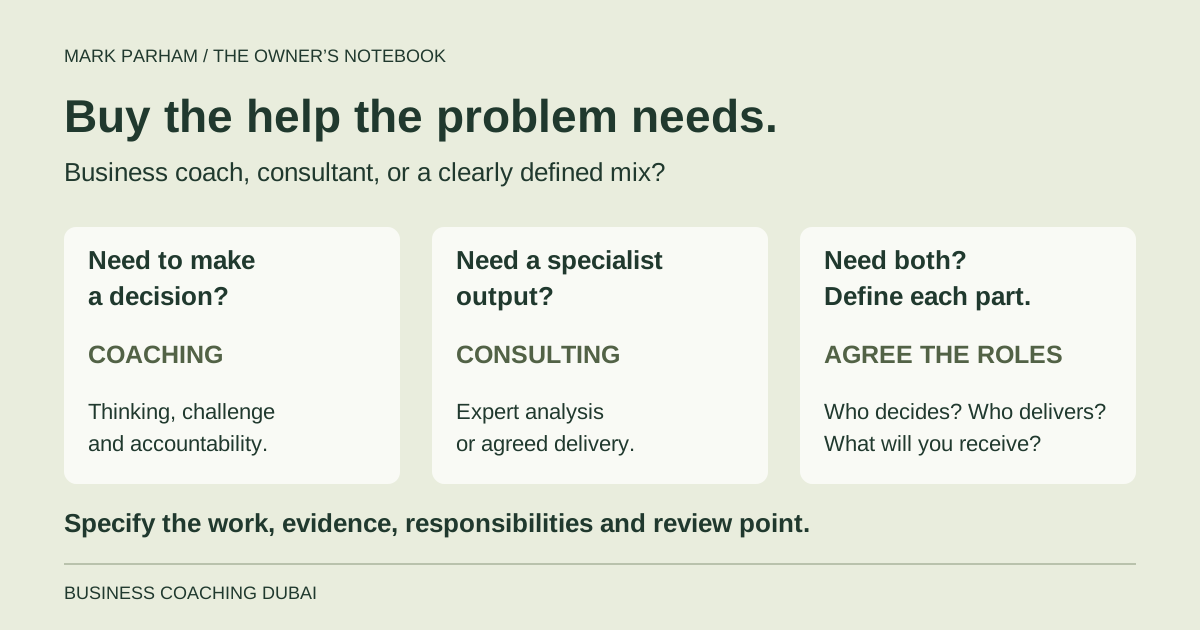
Before comparing profiles, finish this sentence: “At the end of this engagement, we need…” If the answer is a configured system, a specialist assessment or a completed technical project, a series of conversations alone will not meet the brief. If the answer is a decision you keep avoiding, another report may not help either.
I would rather someone buy the right help than buy coaching because the word sounds appealing. A business can have a clear plan and still need an expert to deliver part of it. It can also have plenty of expert advice and an owner who has not chosen what to do next.
Start with the missing capability
Describe the problem without naming a provider. “Our customer follow-up is inconsistent” is more useful than “we need a coach”. Then ask what is missing. Is it a decision about the process, knowledge of how to configure the software, available time to do the work or management attention after launch?
Those gaps can exist together. An owner may need to decide which customer journey matters first, a specialist may need to configure the system, and a team leader may need to maintain it. Buying one person’s time does not automatically cover all three responsibilities.
Look at the evidence you already have. If a previous review produced recommendations, find out why they were not acted on. The recommendations might be wrong, unaffordable or unclear. Alternatively, nobody may have owned the decision. Commissioning another review before answering that question risks repeating the same cycle.
What a coaching engagement should help you do
Coaching can give you a structured space to examine a decision, challenge an assumption, choose an action and review what happened. The owner still has to participate. If you arrive with no information and expect someone else to run the business between calls, the arrangement needs a different description.
The International Coaching Federation’s guidance on the client’s role describes a partnership in which the client contributes to goals and takes action. That is a useful expectation to discuss before paying. It does not mean every coaching conversation must follow an identical method.
A practical output might be an agreed priority, a decision with its assumptions recorded, or a clear experiment and review date. Ask how the provider works and what is included. Useful challenge and accountability are different from promising to make the decisions or produce guaranteed business results for you.
What a consulting engagement should specify
A consultant may investigate a problem, recommend an approach, implement a change or teach your team how to maintain it. The scope determines which of those you receive. Do not assume that a proposal containing the word “solution” includes building, testing, training and ongoing support.
For a system project, you might require a written configuration brief, working workflows, agreed test cases and a handover session. For an operational review, you might require a diagnosis, evidence and prioritised recommendations. These are examples of deliverables to agree, not a standard package every consultant provides.
The Institute of Management Consultants USA’s member ethics emphasise competence, confidentiality, independent advice and charges agreed in advance. Those are useful questions to bring to any supplier discussion. They are professional membership standards, not UAE law or evidence that a particular provider belongs to the organisation.
Compare three ordinary situations
First, imagine an owner with two credible growth options who keeps changing direction. The team starts one project, then abandons it for another. A structured coaching conversation may help the owner define the decision, compare the evidence and commit to a review period. A specialist may still be needed for facts outside their knowledge.
Second, imagine a service business that has agreed its sales process but cannot configure its CRM. The immediate requirement is technical implementation. Ask a suitable specialist for defined work, testing and handover. Coaching the owner does not make a missing integration appear.
Third, imagine the system works but nobody maintains the follow-up discipline. Check the cause. The process may be awkward, the team may lack training or the owner may keep overriding priorities. The answer could involve process improvement, team development or coaching. Diagnose before choosing the label.
Be explicit when the roles are combined
A provider can offer practical advice alongside coaching, or help the owner think through decisions during a consulting project. The problem is not the combination. The problem is leaving the customer uncertain whether they are receiving a suggestion, a specialist recommendation or a commitment to do the work.
The ICF Code of Ethics addresses agreeing roles, responsibilities and financial arrangements, and disclosing when a professional acts in another capacity. I am citing those principles as useful reference points, not claiming ICF credentials or affiliation.
Ask directly: “Which parts will you deliver, which decisions remain mine, and what will my team need to do?” If a provider recommends a tool or another supplier, ask about any commercial relationship. You need to understand the recommendation well enough to assess it.
Make the UAE brief specific
Business setup, specialist compliance work and improving an established business are different briefs. If you need licensing, tax or legal expertise, use someone suitably qualified for that work and the relevant jurisdiction. General business coaching should not be presented as a substitute.
For ordinary operating work, specify the customers, locations, languages and systems involved. A Dubai-based service business delivering across several emirates may need a different handover arrangement from a firm serving clients entirely online. Describe the work rather than assuming the provider will infer it from your address.
Also agree how you will meet and share information. If remote work is suitable, location alone need not determine the choice. If someone must inspect premises or observe a physical process, put that requirement in the brief before comparing fees. Confirm who will actually do the work.
Compare the full commitment, not just the headline fee
A low hourly rate is hard to evaluate when the output and hours are undefined. A fixed fee is equally hard to evaluate when the scope leaves out essential work. Compare the provider’s fee, your team’s time, implementation costs and the ongoing commitments the work may create.
Suppose, purely for illustration, one proposal costs AED 6,000 for recommendations and another costs AED 10,000 including specified implementation and training. The second is AED 4,000 more, but that arithmetic alone does not show which is better value. You need to know whether you can implement the first proposal effectively.
Ask what happens when assumptions change. What is outside scope? What requires a new quote? When can either side stop? What will you receive at that point? Clear answers help you compare actual engagements rather than two sales documents using similar words.
Agree evidence of progress before starting
For coaching, evidence might include decisions made, actions completed and what you learned from testing them. For consulting, it might include accepted deliverables, successful tests and a team that can operate the new process. Keep commercial results in view, but recognise the factors the provider cannot control.
Set an early review point. If the diagnosis changes, discuss whether the engagement still fits. Continuing simply because you have started can be more expensive than stopping to clarify the brief. Avoid guarantees of revenue or outcomes that depend on customers, market conditions and your own execution.
If you have established that coaching is the right type of help, the guide to choosing a business coach covers the next selection questions. If you are comparing coaching fees, use the separate Dubai coaching cost guide.
Write a one-page help-needed brief
Use the free checklist below to record the problem, the missing capability, the required output and who will do what. Add the evidence you have, the constraints and a review date. Send the same brief to any providers you compare.
If your sticking point is an owner decision, bring that brief to a first call with me. We can work through the choices and the next sensible action. If the work requires a specialist implementation, name that requirement clearly rather than expecting a coaching call to replace it.
Put this into practice · Free resource
Coach or consultant decision checklist
Open the worksheet, fill in your own examples and print or save your completed copy. No email needed.